Healthcare | Service Design | Public Sector
OACAO Links2Wellbeing
This was a 12-week academic project with real stakeholders and real constraints. We worked with limited access to the broader OACAO network, and our primary research was concentrated at one SALC site. The solutions reflect what we could validate within that scope. What I'm aiming to show here is how I move from a messy, human problem through research and into something a real organisation could act on.
In line with the professor's encouragement to explore AI in the design process, the following tools were used deliberately at specific stages. Human judgment was applied to validate, select, and synthesise all outputs.
AI tools used
Introduction
"The best way to destroy a social prescribing project is have a staff person leave."
That line came from the OACAO Links2Wellbeing Project Lead, early in our first interview. Across Ontario, the entire coordination infrastructure of social prescribing runs through single individuals at each of 240+ Senior Active Learning Centres. When one coordinator leaves, the service does not slow down. It stops.
Our team was brought in to work with OACAO and the City of Waterloo SALC on the Links2Wellbeing programme, which connects clinicians to community centres for older adults experiencing social isolation.
My Role
What I Was Responsible For
Our team had four members. I led the research phase end to end: I designed the discussion guides, conducted both primary interviews, and deployed a design probe to surface tacit coordinator knowledge. I was one of two people who drove synthesis, and I co-designed both solutions alongside other teammates.
Diagnosing the problem
A referral system running on memory
The more we mapped the process, the more a single pattern emerged:
The Challenge
Redesign the referral infrastructure so the service can function, survive, and share knowledge without depending on any single person.
Design principles
Major Gaps
1. The Referral System
The Waterloo SALC's referral process had grown around one coordinator's personal workflows. As the Links2Wellbeing programme expanded, those workarounds became load-bearing and completely invisible to everyone else.

2. Cracks in the system
As the programme grew, the costs of a person-dependent workflow became harder to ignore:
Research Analysis
Mapping all stages of the service
Synthesis through affinity mapping collapsed eight hours of transcripts and secondary research into three structural failure modes. I then translated those into a service blueprint mapping all eight referral stages — front-stage coordinator actions, back-stage system dependencies, and the exact points where the process broke down. That blueprint became the shared reference for every design decision that followed.
Service Blueprint

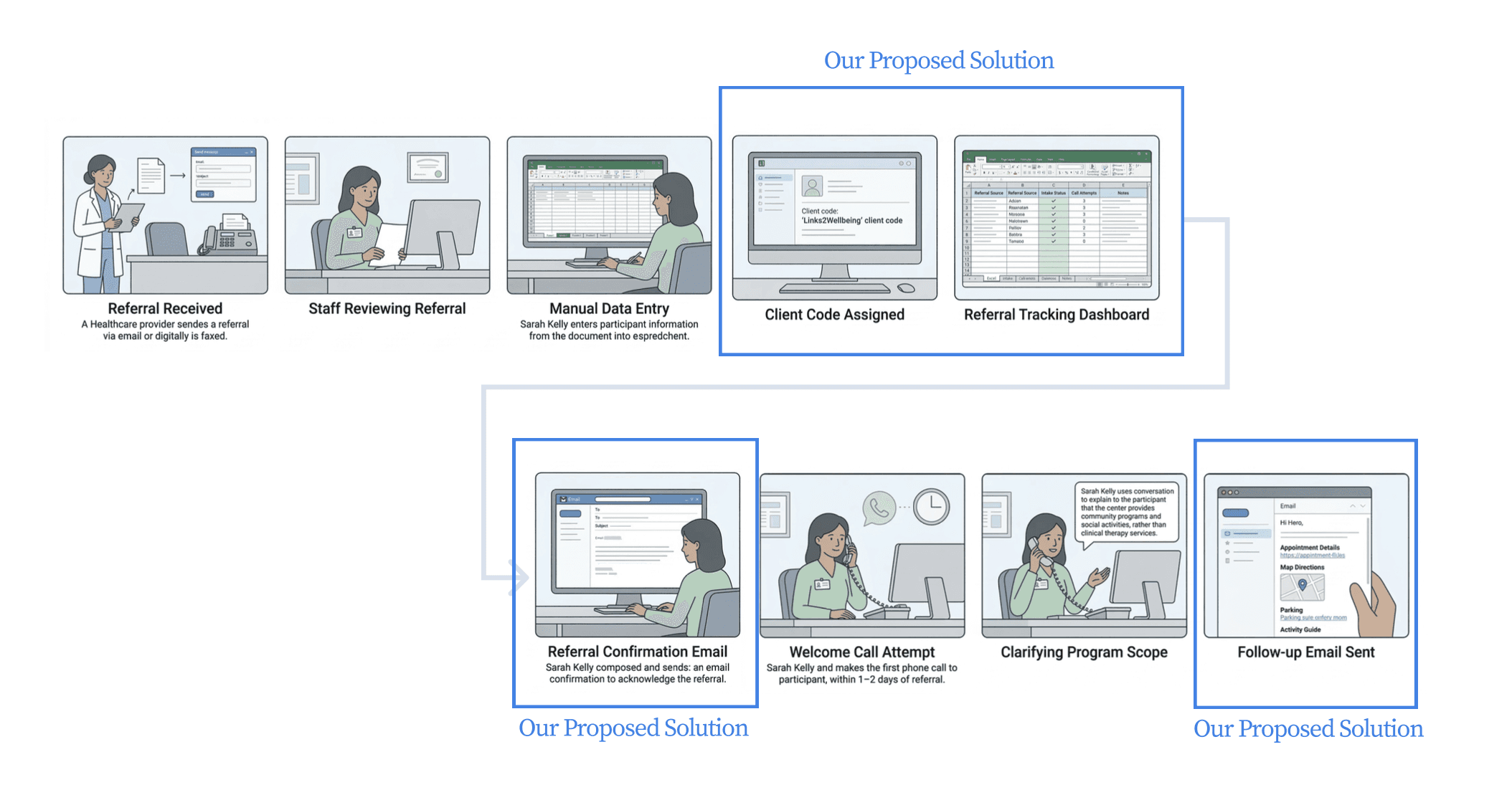
To communicate the redesigned experience to non-technical stakeholders, we scripted and produced storyboards for both solutions. Presenting through storyboards rather than walking through screens let stakeholders see exactly how each touchpoint would change in practice.
Storyboards

Surfaced the 48-hour warm referral window as a concrete, designable constraint. Identified that clinician drop-off was caused by missing confirmation, not lack of interest. Revealed that best practices existed across the network — they just had no way to travel.
Research pointed to two distinct failures — operational and structural. We designed one solution for each.
Solution 1
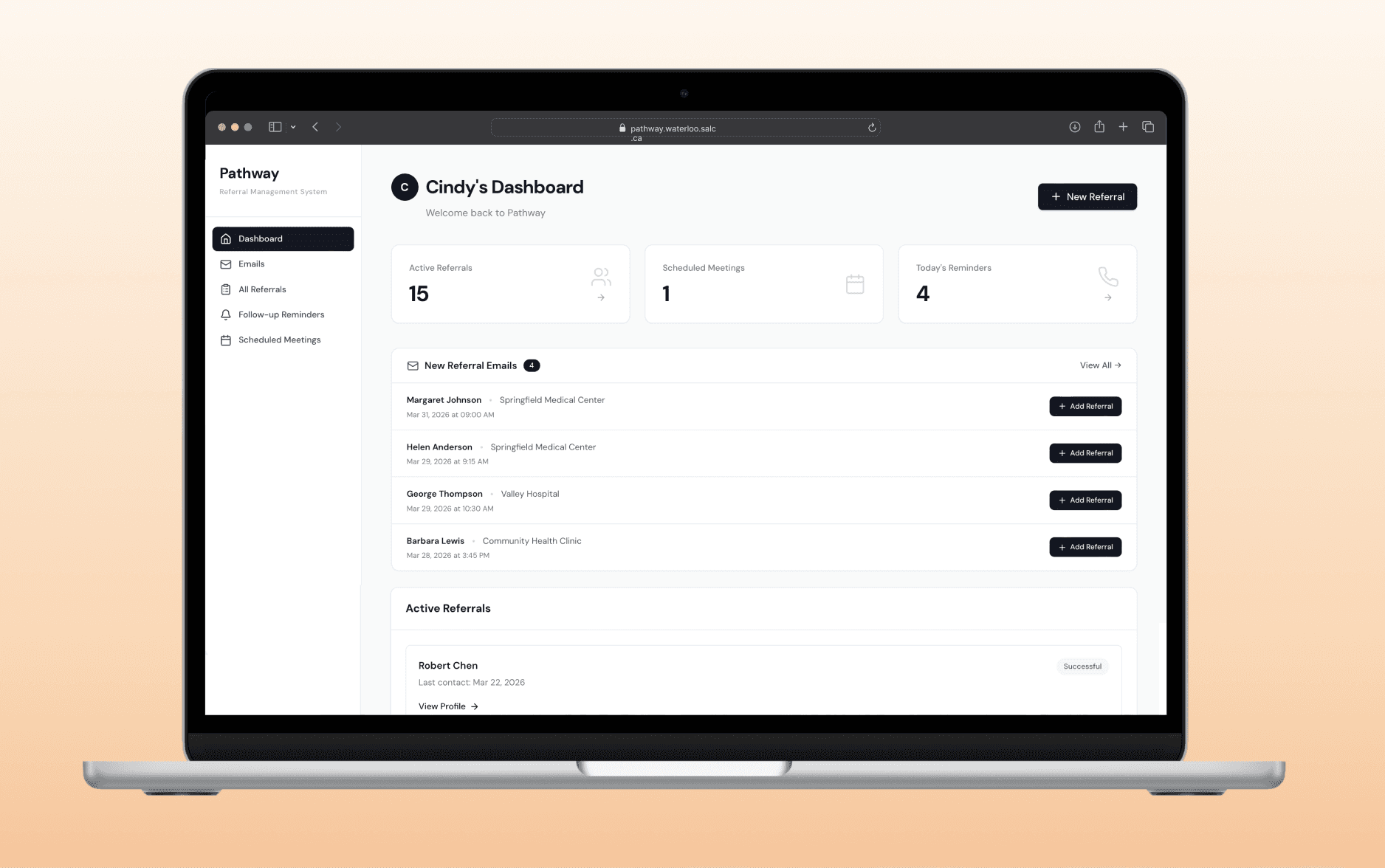
Pathway: Referral Management System
Pathway replaces the 15-tab spreadsheet with a referral management platform coordinators can adopt incrementally. I designed for Airtable and Microsoft Power Apps rather than custom software. OACAO has a platform-freedom policy — tools cannot be mandated across 240+ independent centres so the solution had to work within existing infrastructure with zero procurement friction.
Used Figma Make to rapidly generate UI prototypes and produce proof-of-concept screens for stakeholder review. Allowed the team to test ideas and produce multiple iterations quickly without custom development.

01 Prioritise & Follow Up
The dashboard surfaces overdue follow-ups and new referrals by urgency. Coordinators always know who to call first.

02 Close the Clinician Loop
Pathway has mail integrated and drafts a confirmation email on referral receipt, which can be sent from the system directly.

03 Log Calls & Set Reminders
Every call outcome is recorded. If no one answers, a follow-up reminder is set before the screen closes, reducing extra work for SALC workers.
Solution 2
The SALC Coordinator Playbook
Cross-network research surfaced practices that were genuinely working: calling clients within 48 hours, sending written follow-up emails, giving clients something printed to share with family. Each had been invented independently. None had ever spread. A training programme would not solve this — training requires the knowledge-holder to be present and relies on recall. A physical playbook travels. It sits on a desk. A new coordinator can pick it up on day one.
The Playbook codifies five protocols drawn entirely from practices already working in the network. Nothing in it was invented by our team.

Consolidates five evidence-based protocols from across the SALC network into a single portable document. Deployable at under $3 per coordinator to print and distribute — no funding approval, no procurement, no training schedule required. Reaches all 240+ centres in the OACAO network without any technology dependency.
Video prototype
Proposed Solution
Used Runway ML for scene generation, ElevenLabs for narration, and Adobe Firefly for supporting visuals and interface mockup assets in combination to produce the final video prototype
Outcome
Measuring Success
Both solutions were validated with OACAO and the Waterloo SALC Coordinator before the final stakeholder presentation. The Coordinator's response on seeing the RefLoop prototype: "It would reduce my workload and make me more comfortable sharing responsibility with volunteers." The Playbook was received as immediately deployable. At under $3 per coordinator, it can reach all 240+ SALCs in the network today.
The "What if(s)?"
We explored a single unified platform that combined the referral dashboard and the Playbook protocols in one tool. I moved away from it because it required every centre to adopt the same software — which OACAO's platform-freedom policy makes impossible to mandate. Keeping the two solutions separate meant either one could be adopted independently, at whatever pace each centre could support.